
EDFA Pump Farming: Enhancing Resilience in Submarine Cable Systems
- August 27, 2026
- Posted by: Yunqi Ye
- Category: Submarine Cable Networks
EDFA Pump Farming: Enhancing Resilience in Submarine Cable Systems
Submarine cable systems span thousands of kilometres and rely on numerous repeaters to maintain optical signal strength over long distances. But what happens when a single component within a repeater fails? EDFA (Erbium Doped Fiber Amplifier) pump farming offers an innovative approach to building greater resilience into these critical systems. Explore how this approach works and why it can help keep submarine cable traffic running even when individual pump lasers fail.
The Challenge of Maintaining Long-Distance Submarine Cables and Why Resilience Matters
Consider the longest submarine cable ever built: 2Africa. Covering a distance of over 45,000 km, it has multiple landing points located around the African continent. Its Atlantic Trunk (West Segment) is the longest, stretching from the UK in the north to South Africa in the south, spanning a distance of over 14,000 km. To maintain the strength of the optical signal, repeaters are used throughout with a typical spacing of 60-80km. Assuming a 60-70km repeater span, the Atlantic Trunk segment should have around 220 repeaters.

Another similarly long cable is the Unity cable. Spanning a length of 9,620 km, it is a point-to-point link, connecting Chikura, Japan with Redondo Beach in California, USA. Taking into account the typical repeater spacing, it is assumed that there will be 150-160 repeaters in series.
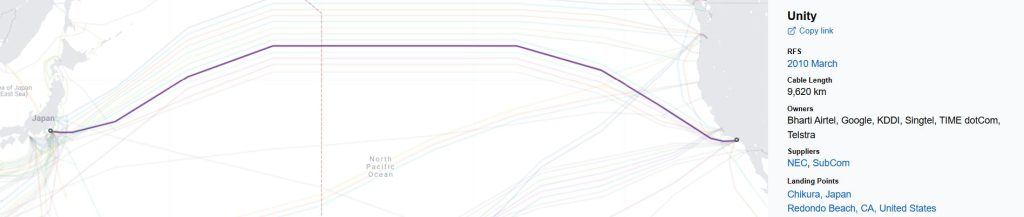
With so many repeaters operating along a single submarine cable, ensuring reliability becomes critical as any failing unit will disrupt the entire link. A repeater fault means sending a specialized cable ship to grapple, cut, and splice the cable at a cost that can run into the millions and take weeks, while the cable is dark. To address this challenge, a novel approach was adopted to build greater resilience in repeater design.
Inside the Submarine Cable Repeater: How EDFAs Work
Submarine cable repeaters are predominantly based on EDFAs (Erbium Doped Fiber Amplifiers), with one EDFA required for each fiber. For example, a cable carrying 12 fiber pairs would require 24 EDFAs within each repeater housing.
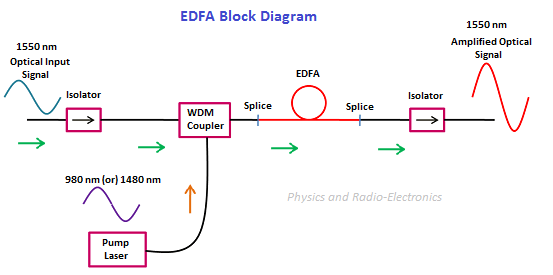
Traditionally, each EDFA is powered by a dedicated laser pump. The pump generates an optical signal of lower wavelength, typically 980nm or 1480nm, which is passed through an Erbium-doped fiber, along with the incoming data signal typically operating in the C-band or C+L band.
As the signal of lower wavelength travels through the Erbium-doped fiber, it excites the Erbium ions to a higher-energy state. When the weaker incoming data signal, such as a 1530-1560 nm C-band signal, passes through this fiber, its photons interact with the excited erbium ions. This interaction causes the ions to return to a lower-energy state while releasing additional photons that closely match the phase, direction, and wavelength of the incoming data signal.
This results in an amplified optical signal that can continue travelling through the submarine cable without the need to convert the signal into an electrical form. In other words, the EDFA strengthens the optical signal entirely within the optical domain, allowing it to travel much longer distances between repeaters.
Figure 3 illustrates this process, showing how the pump laser is coupled with the incoming optical signal before amplification takes place within the EDFA.
The Laser Pump: A Critical Point of Failure
As explained above, the laser pump provides the energy needed for the EDFA to amplify the incoming optical signal. If the pump fails, the EDFA can no longer perform this function, potentially interrupting the optical signal carried by the affected fiber.
So how can repeaters be designed to withstand a pump failure? To improve system resilience, various forms of pump redundancy have been developed and implemented in recent years, culminating in the concept of pump farming, where pump resources can be shared across multiple EDFAs.
Three levels of redundancy:
- 2×2 Pump Redundancy: Two pump lasers collectively serve two EDFAs (transmit and receive). If either laser fails, the other one is fully capable to serve both EDFAs.
- 4×2 Pump Redundancy: Four pump lasers collectively serve two EDFAs (transmit and receive). Up to three laser failures can be tolerated, further increasing resilience.
- Repeater Pump Farming: Pools multiple pump lasers and cross-connects them via optical couplers across multiple fiber pairs, maximizing fault tolerance dynamically.
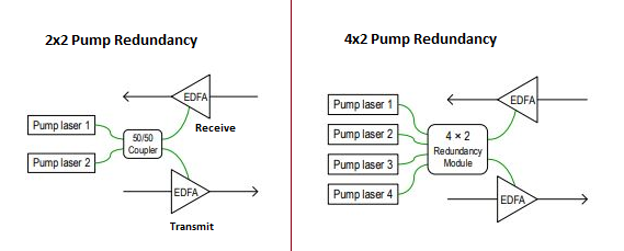
As illustrated in Figure 4 above, the key difference is that the laser pumps are no longer dedicated to individual EDFAs; instead, the available pump power can be shared, providing redundancy in the event of a pump failure.
How Pump Farming Improves Fault Tolerance
The benefit of pump farming becomes clearer when we consider an actual pump failure.
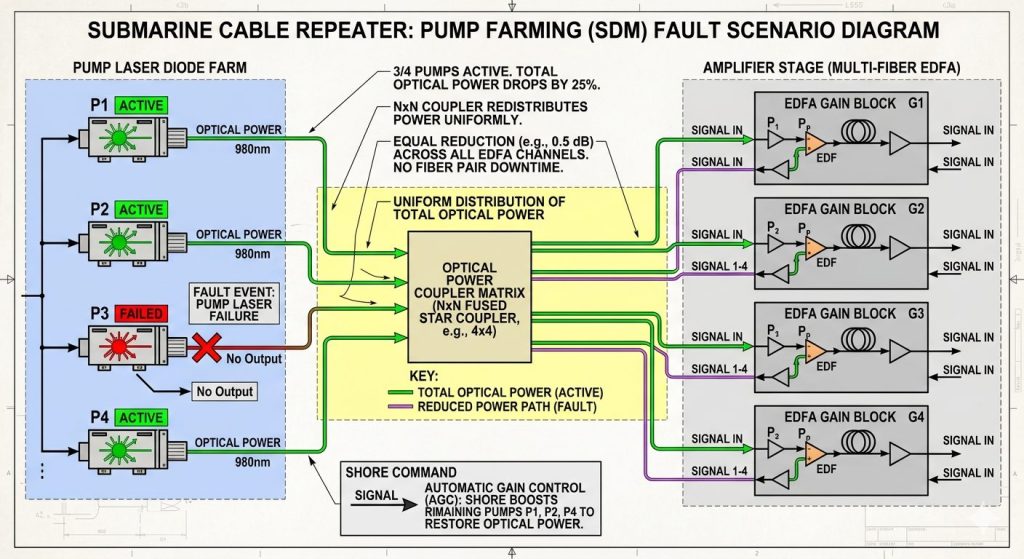
If one laser in an 8-pump farm fails, the total optical pump power available to the star coupler instantly drops by 12.5% (1/8). Because of the symmetric NxM fused fiber coupler, this 12.5% power reduction is distributed equally across every single fiber pair in the cable. No single fiber pair goes dark.
Figure 5 illustrates the same principle in a 4×4 pump farming configuration. When one of the four pump lasers fails, the remaining pump power is redistributed through the optical coupler matrix across all four EDFA gain blocks. Rather than causing one optical path to fail completely, the reduction in available pump power is shared across the amplifier pool, allowing all fiber pairs to remain operational and carry live traffic.
Designing Resilience into Submarine Cable Systems
Pump farming is a clean example of a broader principle in submarine systems engineering: when physical repair is no longer feasible, resilience has to be designed into the architecture itself. The same logic shows up in branching unit design, power feed equipment, and cable route planning.
These are exactly the kinds of system-level questions covered in depth in the Telefocal Certified Submarine Cable Systems Expert (TC-SCSE) course, built for professionals who are already working in or moving into the submarine cable industry.
Learn more and reserve your seat here: https://www.telefocal.com/courses/tc-submarine-cable-system-expert/